


Why Leaders Avoid Owning Decisions
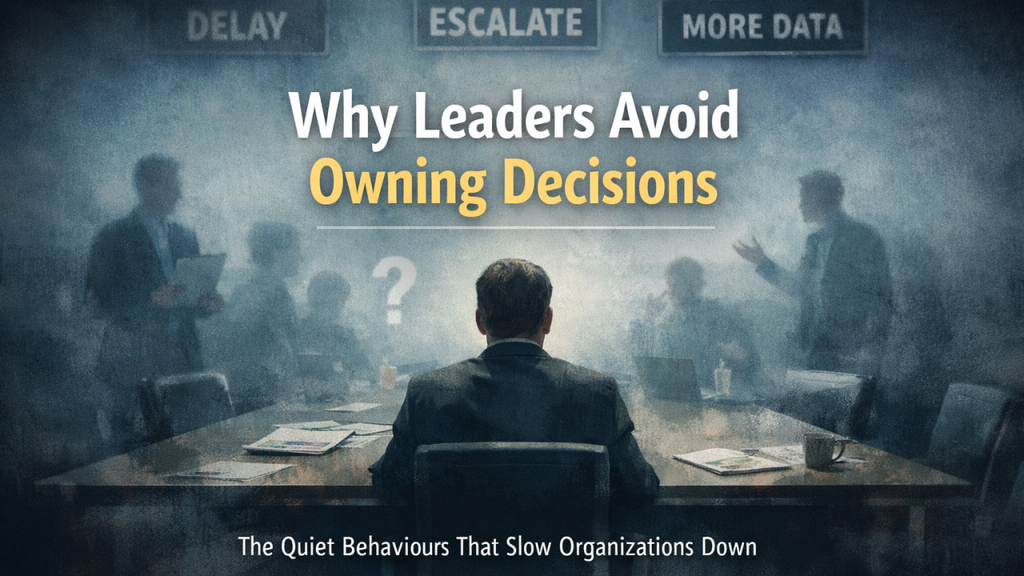
The quiet behaviours that slow organisations down
Leaders are hired to decide. Yet in many organisations, decisions move slowly—or not at all.
This is rarely because leaders lack intelligence, data, or experience. Most organisations are full of capable people who understand the issues well.
What they struggle with is hesitation at the top and diffusion in the middle.
Decision avoidance is not about incompetence. It is about fear, habit, and the signals leaders absorb over time.
What Decision Avoidance Looks Like in Real Life
Decision avoidance doesn’t announce itself loudly. It shows up quietly, in ways most people instantly recognise.
Decisions are discussed repeatedly but never quite closed. Leaders ask for more input long after enough information exists. Matters are escalated in the name of “alignment,” even when the real issue is uncertainty. Committees become safety nets rather than places where decisions are actually made.
In many organisations, not deciding feels safer than deciding wrong.
The organisation stays busy. Conversations continue. But momentum fades.
The Unspoken Reasons Leaders Step Back
Most leaders don’t consciously choose to avoid decisions. They learn to.
They operate in environments where being blamed matters more than being wrong. Where visible mistakes attract attention, but quiet delays pass unnoticed. Where performance systems reward harmony and consensus more than judgment and trade-offs.
Many leaders are also promoted for their technical expertise, not for their decision courage. Over time, the message becomes clear: it is safer to wait, consult more, and escalate.
This is not a leadership failure. It is a system shaping behaviour.
When “Empowerment” Becomes an Escape
This is where decision avoidance often hides.
Empowerment, in theory, is about trust. In practice, it can become abdication.
Leaders push decisions downward without clear boundaries. They invite teams to decide but retain silent veto power. They step in only when outcomes fail, not when direction is needed.
Many leaders don’t avoid decisions openly. They avoid them quietly—under the language of empowerment.
Delegation without clarity does not build confidence. It creates hesitation.
The Cost No One Talks About
The real cost of decision avoidance is not just speed. It is confidence.
Capable managers stop exercising judgment. Decisions flow upward instead of outward. Organisational pace becomes dependent on a few individuals at the top.
Over time, organisations don’t become cautious by design. They become cautious by learning.
People learn what is safe. And they act accordingly.
A Leadership Mirror
Before reaching for frameworks or fixes, it may help to pause and reflect.
Where do decisions keep coming back because no one truly owned them? When was the last time you made a call without full consensus? Do people escalate because they need guidance—or because they need protection? Which decisions would move faster if ownership were explicit?
Discomfort with these questions is not a problem. It is a signal.
Looking Ahead
Avoiding decisions feels safe in the moment.
But organisations build confidence the same way muscles are built—through use.
Closing Thought
Leadership is not about having the right answer every time. It is about being willing to own the answer when it matters.
If this perspective resonates, I invite you to subscribe to my Candid Core newsletter — where I share practical insights on culture, leadership, and the future of work.