

The Skills Shelf-Life Problem
Why the skills that built our careers may not be the skills that define our future
For much of our working lives, acquiring a skill was viewed as an investment with a reasonably long shelf life. We learned a profession, gained experience, refined our expertise, and gradually became more valuable as our knowledge accumulated. The assumption was that experience would compound over time and that the skills we developed would remain relevant, with periodic additions through training and development.
That assumption is becoming harder to sustain.
Technology is changing not only how work is performed, but also which parts of a skill create value. Artificial intelligence, automation, social media, digital platforms and increasingly capable AI agents are moving some activities from specialist tasks to widely accessible capabilities. At the same time, they are creating demand for new combinations of skills that did not previously exist.
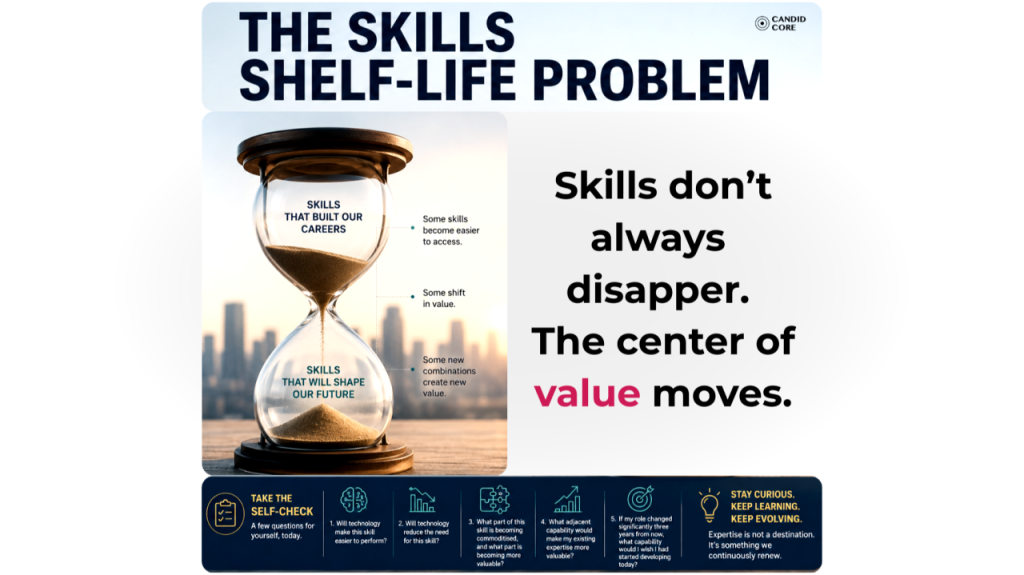
The issue, therefore, may not be that skills are disappearing. It is that their shelf life is becoming shorter, and their centre of value is moving.
That distinction matters.
When a Skill Changes Shape
Consider coding.
There was a time when becoming a good programmer meant developing a deep ability to write code, understand programming languages and solve technical problems line by line. Those capabilities remain important, but AI-assisted coding is changing the economics of how code is produced. Tools can now generate significant portions of code, explain it, suggest improvements, test it and help identify errors.
The value of the programmer does not necessarily disappear. Instead, some of the value shifts.
Understanding the problem, designing the architecture, evaluating whether the generated code is fit for purpose, managing security and performance, and knowing what should be built in the first place become increasingly important.
The skill has not vanished.
Its centre of gravity has moved.
Sales provides another familiar example.
Traditional sales expertise placed considerable emphasis on prospecting, cold calling, product knowledge, presentations and persistent follow-up. Digital channels have changed the process. A salesperson can now use social media, content, data and digital communities to establish credibility and reach potential customers long before the first sales conversation takes place.
AI can take this further by helping with account research, lead prioritisation, personalised communication, proposal development and follow-up.
This does not make sales less important. It changes where the salesperson creates value.
The ability to make hundreds of calls may become less differentiating. Understanding the customer’s business, asking better questions, building trust, interpreting signals and influencing a complex buying decision may become more valuable.
Again, the skill is not disappearing.
The value is moving upstream—from activity to judgment.
Content and image creation are experiencing a similar shift. What once required several specialised capabilities—research, writing, editing, design, photography and production—can increasingly be supported by a single professional using a combination of digital and AI tools.
As production becomes easier, production itself becomes less scarce.
The harder question becomes: What should we create? For whom? Why will it matter? What perspective should it represent? Is it accurate? Is it distinctive? Does it actually achieve its purpose?
When technology makes execution abundant, judgment becomes more valuable.
From Skill Scarcity to Skill Combination
This is perhaps the more significant change taking place.
For decades, careers were often built around functional depth. A person became a finance expert, a marketer, an engineer, a salesperson or an HR professional. Deep expertise remains important, but the future is likely to reward a different combination: deep expertise combined with enough adjacent capability to work effectively with technology and other disciplines.
The salesperson who understands data and AI may have an advantage over the salesperson who relies solely on traditional selling techniques.
The HR professional who combines people expertise with business understanding, analytics and AI may create more value than someone who remains confined to traditional HR processes.
The marketer who combines creativity with customer insight, digital platforms and AI-enabled production may operate very differently from the marketer of a decade ago.
This does not mean everyone needs to become an expert in everything.
It means that the boundaries around professions are becoming more porous.
The future may belong less to the specialist who knows one thing extremely well and more to the professional who has a strong core capability and can connect it intelligently with adjacent capabilities.
What Happens When AI Agents Enter the Workplace?
The next stage could be even more significant.
We have largely experienced AI as a tool that helps a person perform a task. Increasingly, AI is moving towards systems and agents that can execute sequences of tasks with less human intervention.
That changes the question.
It is no longer simply:
“What can AI help me do?”
It increasingly becomes:
“What work should I ask AI to do, what should I continue to do myself, and where should I exercise judgment?”
Imagine a salesperson with an AI agent researching accounts, identifying prospects, preparing briefing notes and drafting personalised outreach.
Or an HR professional using agents to analyse workforce data, identify patterns, prepare reports and support workforce planning.
Or a content professional using AI to research, draft, create visuals and adapt content for different audiences.
The professional is not necessarily doing less.
The professional is doing different work.
The ability to orchestrate technology, validate its output, provide context, make judgments and remain accountable for the outcome becomes increasingly important.
This is where the shelf-life question becomes relevant for every professional—not just those working in technology.
What Might the Next Three to Five Years Look Like?
It would be unwise to predict exactly which jobs will disappear or which skills will dominate by the early 2030s. Technology adoption, regulation, business models and economic conditions will all influence the outcome.
But some shifts are already visible and are likely to accelerate.
Execution is likely to become increasingly augmented by technology. More routine analysis, content production, research, administration and transaction-based activities will be supported or performed by AI and automation.
The premium on judgment is likely to increase. When information and recommendations become easier to generate, deciding what matters, what is credible and what should be done becomes more important.
Hybrid skills are likely to become more valuable. The combination of domain expertise with technology, data, commercial understanding or communication may increasingly differentiate professionals.
The ability to learn and adapt may become a core career capability rather than a development activity. The traditional cycle of learning a skill and applying it for many years may increasingly give way to continuous cycles of learning, applying, adapting and relearning.
And perhaps most importantly, the definition of expertise itself may change.
Expertise may no longer mean simply knowing more than others.
It may increasingly mean knowing what to ask, what to trust, what to challenge, what to combine and when to exercise judgment.
What Does This Mean for HR and Business Leaders?
This creates an important question for HR and business leaders.
Are we still designing careers, job descriptions, learning programmes and workforce plans around relatively stable jobs when the work inside those jobs is changing continuously?
A job description can remain unchanged while the actual work changes dramatically.
A salesperson’s job title may remain “Sales Manager,” while the tools, channels, customer expectations and capabilities required to succeed have changed substantially.
An HR Business Partner may still have the same title, while analytics, AI, workforce transformation and business partnering increasingly reshape the role.
A content specialist may retain the same title while the production process, technology and expectations around output change completely.
This suggests that organisations may need to think less about keeping people trained for a job and more about keeping their capabilities relevant to the work that is emerging.
That has implications for learning, career development, internal mobility, talent management and workforce planning.
The question is no longer simply:
“What training do our people need?”
It may be:
“Which capabilities are becoming more valuable, which are becoming less differentiated, and what new combinations should we start building now?”
A Simple Skill Shelf-Life Check
Every professional can apply the same thinking to their own career.
Take one skill that has been central to your professional value and ask:
Will technology make this skill easier to perform?
Will technology reduce the need for this skill, or simply change how it is applied?
What part of this skill is becoming commoditised, and what part is becoming more valuable?
What adjacent capability would make my existing expertise more valuable?
And perhaps the most important question:
If my role changed significantly three years from now, what capability would I wish I had started developing today?
These are not questions intended to create anxiety.
They are questions intended to create awareness.
Because the objective of future-readiness should not be to constantly chase every new technology or acquire every emerging skill. That would be neither practical nor sustainable.
The objective is to understand where our value comes from today, how that value may change, and what we can do before the change becomes urgent.
The Bigger Shift
Perhaps the future of work is not primarily about jobs disappearing.
Perhaps it is about jobs being continuously redesigned around what technology can do and what humans can uniquely contribute.
Some tasks will become automated. Some skills will become easier to access. Some expertise will become less differentiated. At the same time, new combinations of technical, commercial, creative and human capabilities will emerge.
That means the most important career question may no longer be:
“What skills do I need to succeed?”
It may be:
“Which of my skills will continue to create value as the nature of work changes—and how do I evolve them before I have to?”
For organisations, the equivalent question is even more fundamental:
Are we developing people for the jobs we have today, or building capabilities for the work that is beginning to emerge?
The shelf life of skills may be getting shorter.
But that does not have to be a threat.
It can be an invitation—to stay curious, to keep learning, to combine capabilities differently and to recognise that expertise is not a destination.
It is something we continuously renew.
I would love to hear your experiences and perspectives in the comments.
If this perspective resonates, subscribe to Candid Core Newsletter for more insights on culture, leadership, and the future of work.