

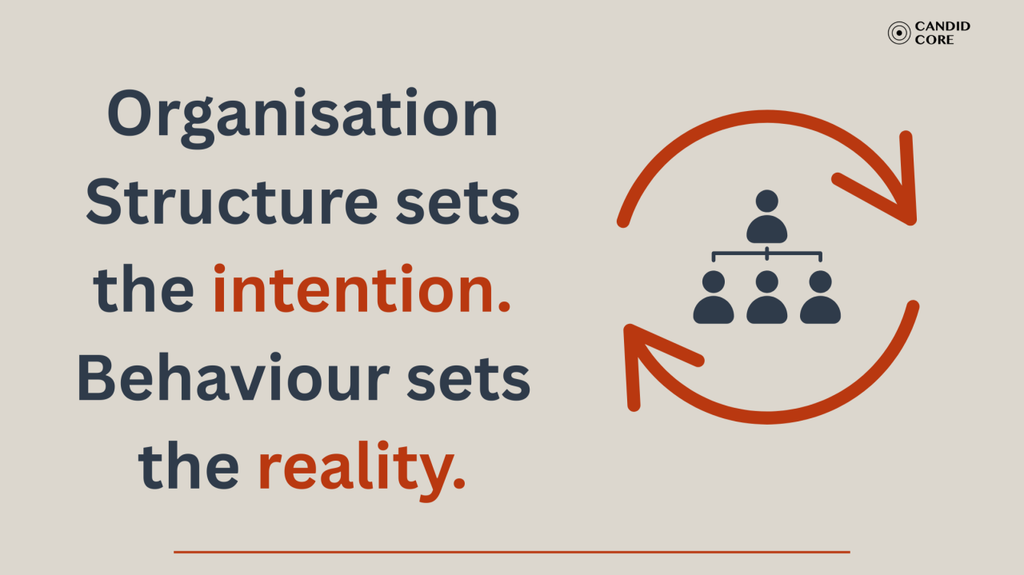
Organisation Structure Sets the Intention. Behaviour Sets the Reality.
Most organisations don’t struggle because their structure is flawed. They struggle because their structure and behaviour do not match.
I see this pattern repeatedly—across startups, mid-sized companies, and even large global organisations. Leaders spend enormous time rearranging reporting lines, refining job descriptions, tightening governance, and designing elegant models. The structure looks logical, modern, even sophisticated.
And yet, within weeks, the organisation slips back into old patterns. People work around the structure. Decisions still bottleneck. Teams still escalate unnecessarily. Cross-functional work still feels heavy.
The uncomfortable truth is this: Structure is how leaders think the organisation works. Behaviour is how it actually works.
And when those two worlds diverge, strategy slows, accountability blurs, and the gap between “design” and “reality” becomes a daily tax on performance.
The Behaviour–Structure Reality Loop™
(An original Candid Core model explaining why organisations work on paper but fail in practice)
Most organisations are unconsciously running a repeating loop—one that determines whether they operate with speed and clarity or friction and confusion.
1. Intended Structure
This is the world leaders architect with intention: the org chart, reporting lines, decision rights, job scopes, operating models. It reflects how work should happen. But this is only the surface layer—an idealised blueprint.
2. Enacted Behaviours
Then comes the messier, more powerful layer: the behaviours people actually demonstrate. This includes whom they trust, whom they go to for real approval, what they escalate, what they avoid, how they negotiate priorities, and what they believe is “safe” or “risky” based on past experience.
These behaviours form the organisation’s unwritten operating system. They quietly override—even rewrite—the intended structure.
3. Experienced Reality
This is the organisation people live in—not the one leaders design. Invisible power centres emerge. Approvals shift to people not shown on the chart. Collaboration patterns reflect history, not design. Meetings multiply because clarity does not. Old habits create new friction.
This reality is where performance is truly won or lost.
4. The Outcome Loop
Outcomes, positive or negative, are not born from structure alone. They arise from the fit between structure and behaviour. Where the alignment is strong, organisations gain speed, clarity, and ownership. Where the alignment is weak, work becomes heavier, slower, and more political than it needs to be.
Over time, these outcomes reinforce themselves—often pushing the organisation into more controls, more exceptions, and more complexity, further distancing it from the design leaders intended.
Why Restructures Fail (Even When the Designs Are Good)
In many restructures I’ve observed or supported, the intent is strong and the design is sound. Yet outcomes disappoint.
Not because the structure was wrong— but because the behaviours needed to run the structure were never addressed.
This is the most consistent flaw in traditional organisation design: we assume structure will drive behaviour, when in reality behaviour decides whether structure survives.
Here’s what typically happens:
- The structure changes.
- But people continue their old habits.
- Informal influence stays where it always was.
- Escalation patterns don’t shift.
- Decision-making remains centralised.
- Teams revert to history instead of adopting the new way of working.
And eventually, the new structure collapses into the old behaviour.
A Real Scenario (anonymised)
A mid-sized organisation redesigned itself into flatter, cross-functional teams. The goal was speed, ownership, and less dependency on senior leaders.
But three months in, the reality looked unchanged:
- Every decision still ran through the CEO.
- Managers avoided conflict and escalated instead of resolving.
- Teams hesitated to own decisions without perceived “cover.”
- Meetings grew because alignment became negotiation.
The structure changed. The behaviour did not. So the business got the old organisation wrapped in a new design.
This is why so many organisations conclude, “Maybe we need another restructure.” When in fact, what they need is behavioural redesign, not structural redesign.
The Core Truth
Organisation design is not lines on a chart. It is behaviour in motion.
A structure only lives through the behaviours people demonstrate— how they collaborate, negotiate, escalate, decide, challenge, prioritise, and trust. This is the real organisational architecture.
Structure sets the intention. Behaviour delivers the outcome. Alignment creates performance.
The Behaviour–Structure Fit Test (For Leaders)
Leaders can quickly diagnose misalignment by asking themselves:
- Are people working in a way that reflects our design, or are they constantly compensating for gaps?
- Does real decision-making match the chart, or do invisible authorities shape outcomes?
- Which behaviours do we reward, tolerate, or silently accept, and how do they define our culture?
- Where do the same frictions repeat across teams, and what does that reveal about our behavioural architecture?
- What behaviours must shift—not just what roles must change—for our structure to truly work?
These questions reveal more about organisational effectiveness than any formal audit.
The Leader’s Imperative
If leaders want their organisation to operate with clarity and speed, they cannot treat structure as a standalone solution. Structure is only the blueprint. The real machinery is behavioural: the habits, norms, informal rules, and quiet expectations that people live by every day.
The next frontier of organisational excellence is not structural redesign—it is behavioural alignment.
When structure and behaviour work in harmony, organisations unlock their full potential. When they don’t, even the smartest design cannot save them.
If this perspective resonates, subscribe to Candid Core for more insights on culture, leadership, and the future of work.