


FOBO — The Fear Is Real. The Solution Belongs to Everyone.
John was good at his job.
Fifteen years in operations. Deep process knowledge. The kind of person teams quietly relied on to get things done. When his company launched its AI transformation program, John was one of the first people invited into the room.
They called it a “co-creation initiative.” Employees and leadership, working together to shape the future of how the organization would run. John attended every session. He shared his knowledge openly — how workflows actually functioned on the ground, where the inefficiencies were, what a smarter system could look like. He believed he was helping build something better. He believed he was part of it.
Eight months later, John was handed a redundancy notice.
The AI system — informed in part by what he and his colleagues had shared — was now handling a significant portion of what his team used to do. The transformation was complete.
John didn’t just lose his job. He lost something harder to name — his confidence, his sense of professional identity, and his belief that his experience still made him valuable in a world moving this fast.
He is not alone. Not even close.
There Is a Name for What People Are Feeling
We have heard a lot about the fear of job loss due to AI. That fear is real.
But something more specific — and in many ways more quietly damaging — is spreading through workplaces in 2026.
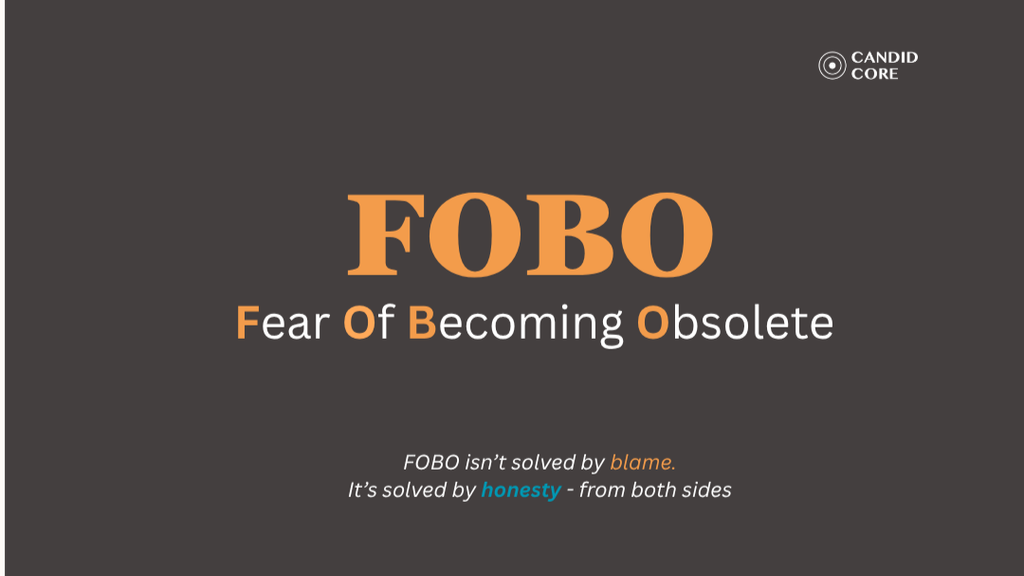
It is called FOBO. The Fear of Becoming Obsolete.
And it is different from the fear of losing your job.
Losing your job is an event. FOBO is a slow erosion. It is the creeping sense that even if you keep your job today — your skills are quietly degrading, the gap between where you are and where the world is heading is widening, and you are not sure you can close it fast enough.
It is the feeling of sitting in a meeting where AI tools are being discussed, nodding along, while privately thinking: “I don’t even know where to begin.”
It is professional confidence, quietly replaced by self-doubt. And it shows up in performance, in engagement, and eventually — in the decision to either withdraw or leave.
FOBO is real. It is widespread. And it deserves an honest conversation — not a one-sided one.
First, Let’s Be Honest About the Organizations
It would be easy to write this article as a straightforward case against organizations and leaders. There is enough evidence to build that argument.
But it would not be a complete or fair one.
Here is the reality that most commentators skip over:
Organizations transforming through AI are not, in most cases, doing so out of indifference to their people. They are doing so because the alternative — standing still — carries its own very serious consequences. A business that does not adapt to AI risks losing competitiveness, losing customers, and ultimately losing the ability to sustain any jobs at all. That is not a hypothetical. It is already happening to organizations that moved too slowly.
Leaders navigating this are caught in a genuine catch-22. Move fast and risk leaving people behind. Move slowly and risk the organization falling behind. There is no clean answer. There is no path through this that is without pain.
John’s story is painful. And it is also true that the organization he worked for was likely making decisions under real pressure — commercial, competitive, and financial — that did not allow for a perfect outcome.
Acknowledging this is not excusing poor execution. It is being honest about the environment in which these decisions are being made.
What organizations can be held accountable for is not the transformation itself — but how they carry it out. The difference between a transformation that destroys trust and one that preserves it is not the outcome. It is the honesty, transparency, and genuine care applied to the process.
Now, Let’s Be Equally Honest About Employees
Here is the part that is harder to say — but equally important.
Not every experience of FOBO is the same. For many employees, it is a genuine and understandable response to a fast-moving, uncertain environment. For some, however, FOBO has become a quiet justification for not engaging with the change at all.
The uncomfortable truth is this: adaptation in the age of AI is not optional. It never has been in any previous era of significant technological change — and this one is no different, except in pace.
There are employees who are proactively learning, experimenting, asking questions, and finding ways to make themselves more relevant. And there are employees who are waiting — for the organization to hand them a solution, for things to slow down, for someone else to figure it out first.
Waiting is a choice. And it carries consequences just as real as the decisions organizations are making.
This is not about blaming individuals for feeling anxious. Anxiety in the face of this much change is human and understandable. But anxiety and inaction are two different things. The first is something to be supported. The second is something to be honestly addressed — by the individual, and by the people around them.
A candid conversation about FOBO cannot be complete without saying this clearly: employees have a role to play in their own relevance. Not alone. Not without support. But actively, not passively.
The Catch-22 Only Gets Resolved in One Way
Here is what both sides of this conversation have in common:
Neither can solve it alone.
An organization that drives transformation without bringing its people along will achieve short-term efficiency and long-term cultural damage. The cost of that — in trust, in retention, in the quiet disengagement of experienced talent — will show up eventually. It always does.
An employee who waits for the organization to hand them relevance, while the world accelerates around them, will find that the gap becomes harder and harder to close. Good intentions without action do not build new capabilities.
The only path through FOBO — for both sides — is the same:
Honesty. Transparency. And proactive engagement — simultaneously.
Not sequentially. Not one side waiting for the other to go first. Both, at the same time.
What This Looks Like in Practice
For organizations and leaders:
Be specific, not vague. When roles are changing, say so clearly — and say what it means for the individual in front of you. Vague reassurance is worse than silence. It creates distrust without creating clarity.
Be honest about the pressure you are under. Employees are not naive. They read the news. They understand market realities. A leader who acknowledges the difficulty of the moment, rather than packaging it in optimistic corporate language, builds far more trust than one who pretends everything is under control.
Invest in people before the transformation, not as a footnote to it. Upskilling that happens after a restructuring announcement feels like damage control. Upskilling that happens as a genuine, ongoing commitment before change arrives feels like care. The timing sends a message as loud as the content.
Create space for honest conversations — at the team level, not just in town halls. Ask not just “how are you using the new tools?” but “how are you feeling about where your role is heading?” That question, asked genuinely and followed up with real support, changes the relationship between a manager and their team.
For employees:
Get curious before you get anxious. Anxiety about AI is understandable. But curiosity is more useful. Start small — one tool, one new skill, one conversation with a colleague who seems to be adapting well. Relevance is not rebuilt in one leap. It is rebuilt in small, consistent steps.
Ask for what you need — specifically. “I am worried about staying relevant” is a hard thing to say. But it is a far more productive conversation than staying silent and hoping someone notices. Most leaders and HR professionals want to support their people through this. They cannot support what they cannot see.
Be honest with yourself about where you are genuinely trying and where you might be avoiding. That is not a comfortable question. But it is a necessary one.
Recognize that your experience is still an asset — but it needs to evolve. Fifteen years of deep operational knowledge, combined with a growing understanding of how AI can enhance that work, is a powerful combination. The goal is not to become a technologist. The goal is to stay relevant by connecting what you already know to what the world needs next.
Where Trust Gets Built
The organizations that will come out of this era with strong cultures and strong people are not necessarily the ones who had the smoothest transformations. They are the ones where — even in difficult moments — there was enough honesty on both sides to keep the relationship intact.
Where leaders said: “This is hard for us too. Here is what we know. Here is what we don’t. Here is how we are going to support you.”
And where employees said: “I am finding this difficult. Here is where I need help. And here is what I am willing to do.”
That kind of honesty does not come naturally in most organizations. It requires psychological safety, genuine leadership, and a culture where telling the truth is valued over maintaining appearances.
But when it exists — FOBO loses its power. Not because the uncertainty goes away. But because people are no longer facing it alone, in silence, on opposite sides of an unspoken divide.
A Challenge — For Both Sides
If you are a leader or HR professional reading this:
When did you last have a genuinely honest conversation with your team — not about AI adoption rates or transformation milestones, but about how your people are actually feeling about their own relevance and future?
If you are an employee reading this:
When did you last ask yourself — honestly — whether you are engaging with this change, or waiting for it to pass?
Both questions are uncomfortable. Both matter equally.
FOBO is real. But it is not inevitable. It shrinks in the presence of honesty, shared accountability, and the willingness of both sides to stop waiting for the other to go first.
Where do you stand on this? I would love to hear from both leaders and employees in the comments — what has worked, what has not, and what you wish the other side understood better.
Candid Core is a newsletter about leadership, management, and culture — written without the jargon. If this resonated, share it with someone on either side of this conversation who needs to read it today.