


Fixing the Middle: The Untapped Powerhouse for Strategy Execution
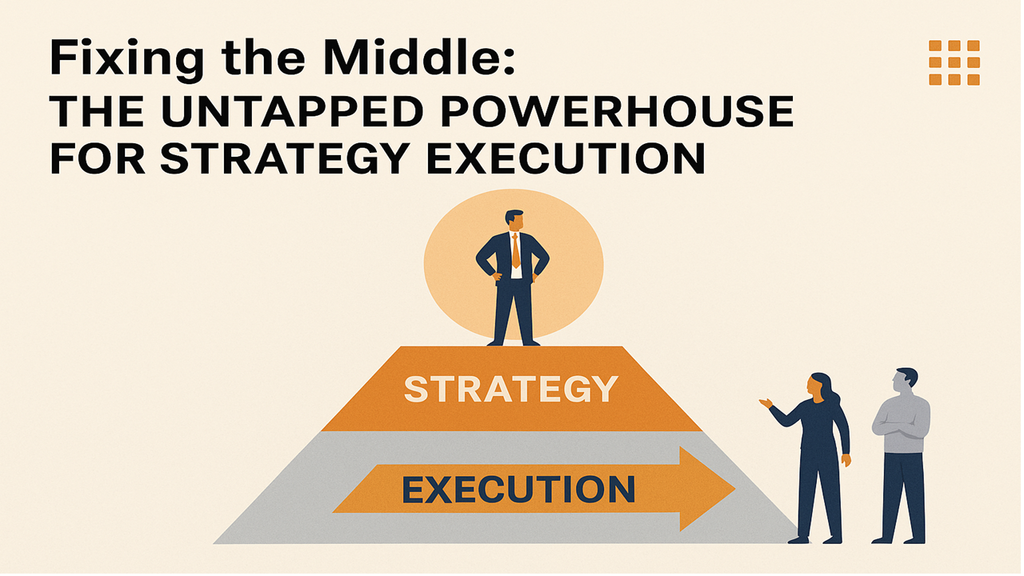
In most organizations, strategy fails not because the vision is flawed but because the execution falters. Surprisingly, this breakdown rarely occurs at the top or bottom—it happens in the middle. Mid-level leaders, often overlooked and underprepared, are the crucial link between strategy and outcomes. They are expected to translate vision into daily decisions, influence teams across functions, manage ambiguity, and drive change—yet they are seldom empowered or equipped to do so.
The Overlooked Layer
In my experience across industries, it’s common to see organizations draft robust strategies with optimism at the top, while the frontline waits for direction. But the layer in between—the mid-level leadership—often struggles silently. They’re expected to “make it happen,” yet are rarely part of the planning process. Many report sentiments like:
“I agree with the decision, but I wasn’t involved. I just have to implement it now.”
“No one asked for our input—we just got the direction.”
These statements are not complaints; they are signals of a layer that is misaligned, unsupported, and disconnected from strategic intent. Nowhere is this more evident than during key initiatives—product launches, pricing campaigns, and operational shifts—where execution success hinges on this group’s ability to lead.
The Cost of Neglect
Multiple research findings reinforce this reality:
- McKinsey reports that only 30% of organizational transformations succeed. A major reason? Lack of mid-level engagement.
- Gallup shows that 70% of team engagement is driven by the manager—usually the second line.
- Gartner highlights that only 22% of employees believe their leaders have a clear plan for execution.
The takeaway is clear: If your second line isn’t ready, your strategy isn’t real.
Understanding the Disconnect
What does this look like on the ground?
- Senior leaders build bold strategies.
- Frontline teams await detailed instructions.
- Mid-level managers—stuck in the middle—are forced to absorb pressure without clarity or support.
Instead of becoming leaders of impact, they often:
- Relay messages instead of making meaning
- Follow processes rather than shaping direction
- Manage people without growing them
This isn’t a talent issue—it’s a systems issue. When organizations overlook this layer, they effectively weaken the bridge between vision and reality.
Common Missteps
Here are three common ways organizations undercut their own strategy execution:
- Assumption of Self-sufficiency: Assuming mid-level leaders will “figure it out” without structured support.
- Generic Leadership Programs: Providing one-size-fits-all training that fails to address the nuance and pressure of mid-level leadership.
- Lack of Context and Authority: Expecting ownership without providing clarity, influence, or decision rights.
What Progressive Organizations Do Differently
Organizations that succeed at execution treat the second line as strategic enablers, not operational intermediaries. They:
- Involve mid-level leaders in the design of execution plans
- Provide deep context, not just instructions
- Invest in tailored development—coaching, peer forums, mentoring
- Create clarity around expectations, ownership, and authority
By closing the gap between intent and capability, they build execution muscle into the organization.
Diagnosing the Warning Signs
If your organization is unsure about the strength of its middle layer, consider these common warning signs:

These are not individual failings—they are system-level signals that your middle layer may be underpowered.
A Practical Path Forward: The C.O.R.E. Framework
At Candid Core, we support organizations in strengthening their second line using a focused enablement approach:

C – Clarity: Define how strategic goals translate into functional and team-level outcomes. Ambiguity at this level creates hesitation and resistance.
O – Ownership: Involve mid-level leaders in shaping the execution roadmap. Empower them with autonomy, not just accountability.
R – Readiness: Build relevant leadership capabilities—such as influencing without authority, navigating complexity, and leading in hybrid setups.
E – Enablement: Create structured systems—coaching, peer learning forums, ongoing feedback—to support real-time decision-making and development.
A Business Imperative, Not Just an HR Concern
Execution is not a process—it’s a leadership behavior. And that behavior is lived and reinforced every day by your second line. If you are serious about achieving your strategic goals, you must be serious about who is carrying them forward.
Neglecting this layer is not just a developmental oversight—it’s a business risk.
Final Reflection
What would shift in your organization if mid-level leaders were not just executing strategy, but actively shaping and enabling it?
If your answer suggests a gap—it’s time to fix the middle.
If this reflection resonates with you, subscribe here for more editions of Candid Core where we explore practical insights at the intersection of HR, Leadership, and governance.