

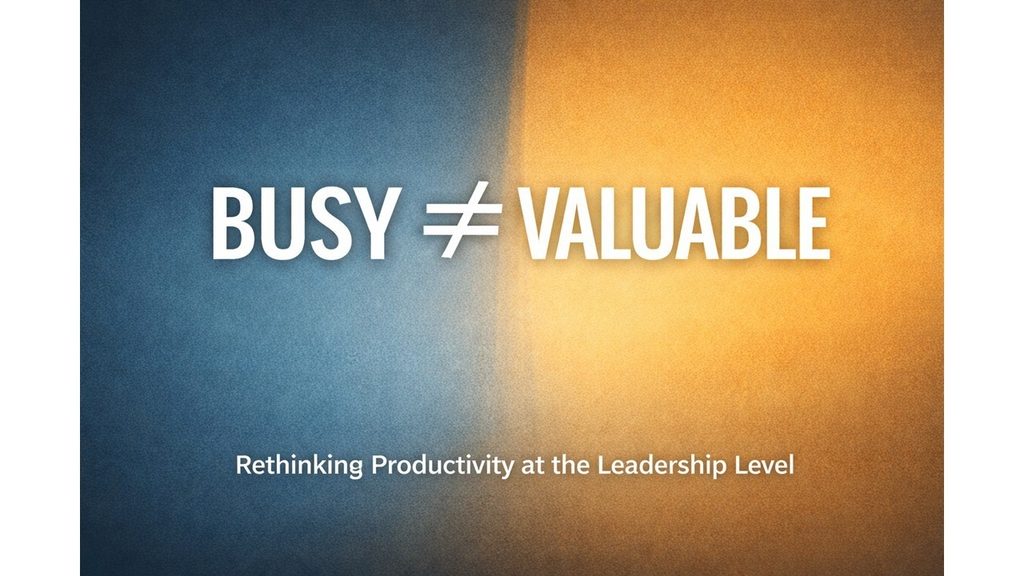
Busy ≠ Valuable: Rethinking Productivity at the Leadership Level
There’s a familiar rhythm to leadership today.
Back-to-back meetings. A constantly full inbox. Endless follow-ups. Very little time to think.
At the end of the day, it feels like a lot was done.
And yet—very little seems to have moved.
Decisions remain pending. Priorities feel blurred. Teams stay active, but outcomes feel average.
We are exhausted—but not effective.
This is the quiet paradox of modern leadership: we’ve optimized for busyness, not value.
A Moment That Feels Familiar
A business leader I recently worked with shared this candidly:
“My days are packed. I’m in every critical discussion. I respond quickly. I’m always available. But somehow, things don’t move unless I personally step in.”
On reflection, a clear pattern emerged. The leader was present in most meetings, yet decisions were often deferred. Teams stayed active—but waited for direction, even on solvable issues. Priorities were discussed frequently, but not always clarified.
The intent was right: stay involved, stay responsive, stay supportive.
But the outcome was different.
High activity. Low movement.
This is not an isolated story.
How the Busyness Trap Shows Up
The challenge is that busyness rarely looks like a problem. In fact, it often appears as commitment, ownership, and drive—and gets rewarded accordingly.
Take the always-on leader. Highly responsive, always available, quick to step in. Over time, however, teams begin to rely on that responsiveness. Decisions move upward by default, and ownership slowly fades. What gets rewarded is speed—but what gets diluted is accountability.
Or consider the meeting-heavy culture. Calendars are full and discussions are constant. Yet the same topics resurface week after week. Decisions are revisited rather than resolved, and conversations begin to substitute for closure. Participation is visible—but progress is not.
Then there’s the visible effort performer. Long hours, high involvement, always “busy.” The intent is commitment, but the outcome is often stretched work rather than better work. Output doesn’t proportionately improve, and over time, others begin to mirror the same pattern—effort gets rewarded, while effectiveness quietly fades.
In some environments, this extends into an escalation-driven culture, where leaders frequently step in to solve and unblock. While helpful in the moment, it gradually slows decision-making, builds dependency, and turns leaders into bottlenecks. Leader involvement increases—but team capability weakens.
These patterns don’t emerge because people are ineffective.
They emerge because systems and signals reward activity more visibly than value.
The Busyness Trap
Most organizations don’t explicitly ask leaders to stay busy—but they unintentionally reward it.
Over time, activity becomes a proxy for contribution. Visibility becomes a proxy for impact. Responsiveness becomes a proxy for effectiveness.
And slowly, without intent, leaders begin to equate being busy with being valuable.
But the two are not the same.
Busyness is motion. Value is movement.
One fills time. The other changes outcomes.
The Cost of Busyness
The impact of this trap is rarely immediate—but it is always cumulative.
Decisions begin to slow down, even as discussions increase. Focus gets diluted as everything feels important. Leaders, despite their effort, become bottlenecks rather than enablers.
At the team level, effort rises—but clarity does not. People start optimizing for visibility instead of outcomes, and high performers disengage from work that feels low in impact.
And perhaps most critically—leaders lose the space to think. Strategy gives way to constant execution, and reflection gets replaced by reaction.
Busyness doesn’t just consume time—it quietly erodes effectiveness.
Rethinking Productivity: From Activity to Value
Leadership effectiveness begins with a simple but powerful shift.
Not: How much did I do?
But: What changed because of me?
This shift—from activity to value—is where meaningful leadership begins.
The VALUE Lens for Leadership Productivity
To make this shift practical—and sustainable—leaders need a way to consistently reflect and recalibrate their impact.
The VALUE Lens
V – Value Created Did something move forward because of you?
A – Alignment Driven Did you bring clarity to priorities?
L – Leverage Built Did you enable others—or stay at the center?
U – Unblocked Progress Did you remove barriers or accelerate decisions?
E – Energy Directed Did your time go where it truly matters?
From Concept to Practice
The VALUE Lens becomes powerful when it is used consistently—not occasionally.
A simple weekly ritual can make a meaningful difference. Taking just 15 minutes at the end of the week to reflect can shift how leaders operate:
- Where did I create real movement?
- Where was I just busy?
- Did I enable progress—or become a bottleneck?
- What consumed energy without meaningful return?
Over time, patterns begin to emerge—where value is created, where time is diluted, and where involvement needs to change.
This is where leadership shifts—from effort to impact.
Leaders who build this discipline tend to prioritize better, engage more deliberately, and create greater outcomes with less effort.
In a world of constant activity, reflection becomes a competitive advantage.
Leadership Productivity Check
- How much of my time creates real movement?
- Do my meetings end with decisions—or just discussions?
- Am I enabling others—or becoming a bottleneck?
- Do I reward effort more than outcomes?
- If I removed 30% of my work, would outcomes actually change?
Closing Thought
Busyness often feels like contribution—but it is frequently a sign of misalignment.
The goal is not to do more.
It is to ensure that what you do actually matters.
Because leadership is not measured by how much you handle—
but by how much you move.
If this perspective resonates, subscribe to Candid Core for more insights on culture, leadership, and the future of work.